You built something original — a logo, a formula, a song, an invention. Then you find someone else using it without asking. That gap between “I made this” and “I can stop others from stealing this” is exactly what IPR meaning covers. This guide breaks down what the term actually stands for, why it protects your work, and how to use that protection before someone else does.
What Is IPR Meaning? A Simple Definition
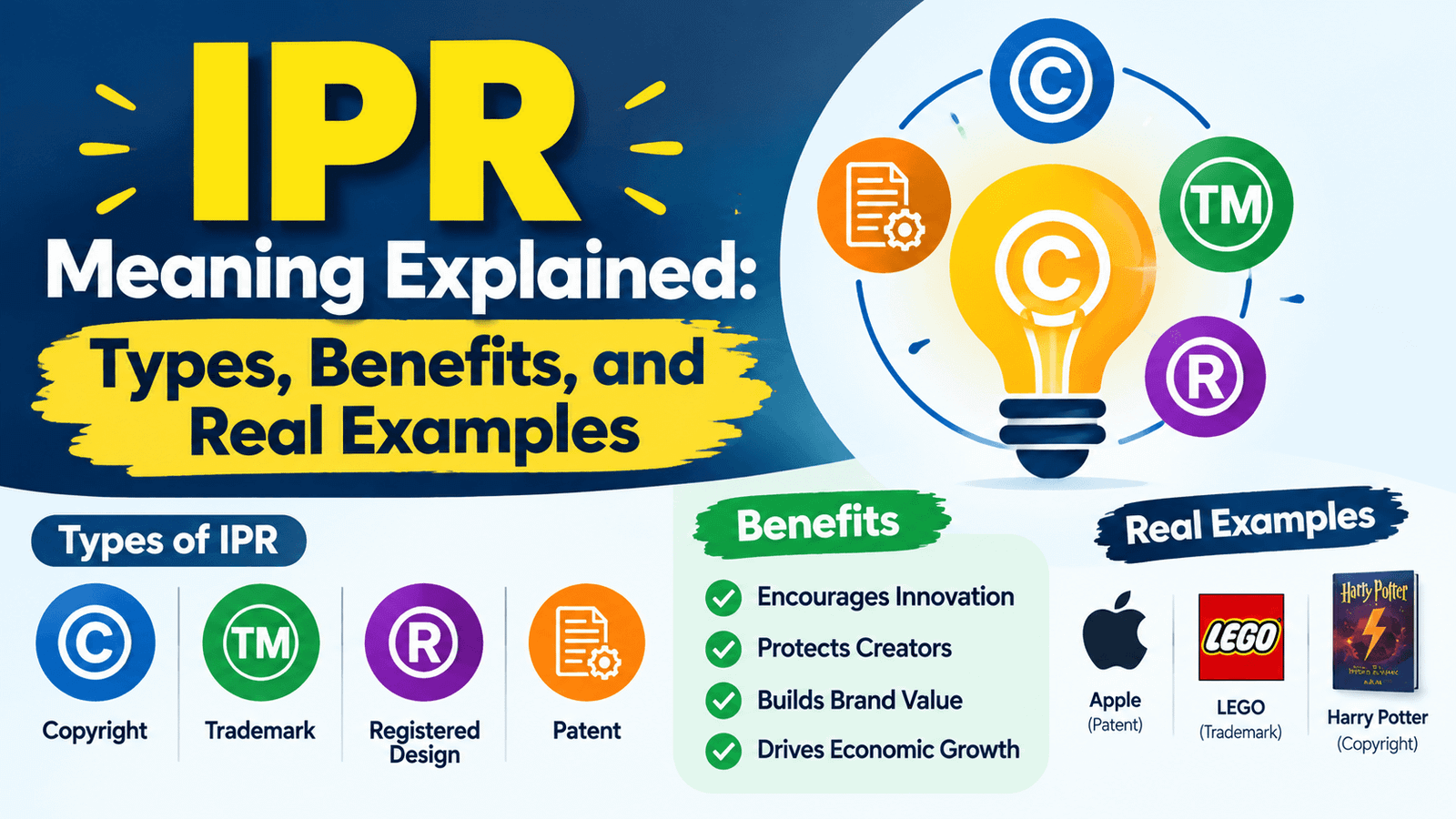
IPR meaning refers to the legal rights given to a person or company over the things they create with their mind. IPR stands for Intellectual Property Rights. These rights cover inventions, brand names, designs, written works, music, and business formulas.
The core idea behind this concept is simple: if you create something original, the law lets you control how others use it. You decide who can copy it, sell it, or build on it. Without this protection, anyone could take your idea and profit from it without paying you a single rupee, dollar, or euro.
Governments around the world enforce these rights through national laws and international treaties. Bodies such as the World Intellectual Property Organization (WIPO) and the World Trade Organization (WTO) set global standards that most countries follow.
IPR Full Form and Where the Concept Comes From
The IPR full form is Intellectual Property Rights. Each word tells you something:
- Intellectual — the property comes from human thought, not physical labor alone.
- Property — it can be owned, sold, licensed, or inherited, just like land or a car.
- Rights — the law backs your ownership and gives you tools to defend it.
Once you understand the IPR full form, the meaning behind it becomes much easier to remember: it’s ownership over ideas, not just objects.
A Short History of Intellectual Property Rights
Intellectual property protection is not a new concept. Venice passed one of the first patent laws in 1474 to protect inventors. England followed with the Statute of Anne in 1710, the earliest copyright law protecting authors.
This modern framework took global shape after the Paris Convention (1883) for industrial property and the Berne Convention (1886) for literary and artistic works. Today, the TRIPS Agreement under the WTO sets minimum IPR standards that member countries must follow, which is why IPR meaning looks similar across most nations even though local laws differ slightly.
Types of Intellectual Property Rights (With Examples)
To fully grasp IPR meaning, you need to know its six main branches. Each one protects a different kind of creative or commercial work.
1. Patents
A patent protects a new invention or a new way of doing something. It gives the inventor exclusive rights to make, use, or sell the invention for a fixed period, usually 20 years.
Example: A pharmaceutical company patents a new drug formula so competitors cannot copy it for two decades.
2. Trademarks
A trademark protects brand identity — logos, names, slogans, and symbols that distinguish one business from another.
Example: The golden arches of McDonald’s or the swoosh of Nike are trademarks that instantly identify the brand.
3. Copyrights
Copyright protects original creative works such as books, films, music, paintings, and software code. It does not protect the idea itself, only the specific expression of that idea.
Example: An author automatically holds copyright over a novel the moment it is written down.
4. Industrial Designs
This protects the visual design of a product — its shape, pattern, or ornamentation — rather than its function.
Example: The unique curved shape of a perfume bottle can be registered as an industrial design.
5. Geographical Indications (GI)
A GI tag protects products tied to a specific region, where the quality or reputation comes from that location.
Example: Darjeeling Tea and Champagne can only carry those names if produced in their respective regions.
6. Trade Secrets
Trade secrets protect confidential business information such as formulas, processes, or customer lists that give a company a competitive edge.
Example: The Coca-Cola formula has remained a trade secret for over a century instead of being patented, since a patent would have expired long ago.
Complete IPR Meaning Table: Types, Duration, and Governing Law
| Type of IP | What It Protects | Typical Duration | Governing Authority (India/Global) |
|---|---|---|---|
| Patent | New inventions, processes, machines | 20 years from filing | Patent Office / USPTO / EPO |
| Trademark | Brand names, logos, slogans | 10 years, renewable indefinitely | Trademark Registry / USPTO |
| Copyright | Books, music, films, software | Author’s life + 60–70 years | Copyright Office |
| Industrial Design | Shape, pattern, appearance of products | 10–15 years | Design Office / WIPO |
| Geographical Indication | Region-specific products | Indefinite, with renewal | GI Registry / WIPO |
| Trade Secret | Confidential formulas, processes | Indefinite, as long as kept secret | Protected via contracts, not registration |
This table shows why intellectual property protection cannot be reduced to one single law — each type of intellectual property has its own registration process, duration, and protecting authority.
Why Understanding IPR Meaning Matters for Businesses
Every founder, freelancer, and inventor should understand these rights before launching a product. Here’s why it directly affects your bottom line:
- It stops competitors from copying your brand name or product design.
- It turns your ideas into sellable assets you can license for royalty income.
- It increases your company’s valuation during funding or acquisition talks.
- It gives you legal standing to sue and claim damages if someone infringes your work.
- It builds customer trust, since a registered trademark signals a legitimate business.
A business that ignores intellectual property protection often discovers the cost only after a competitor has already copied its idea and captured the market first.
IPR Meaning Across Different Countries
While this protection stays consistent worldwide in principle thanks to the TRIPS Agreement, the process and timelines vary by country.
| Country | Patent Filing Authority | Average Patent Grant Time | Trademark Validity |
|---|---|---|---|
| India | Indian Patent Office (IPO) | 2–3 years | 10 years, renewable |
| United States | USPTO | 1.5–2.5 years | 10 years, renewable |
| European Union | EPO | 3–5 years | 10 years, renewable |
| United Kingdom | UK IPO | 2–3 years | 10 years, renewable |
Businesses that operate globally often file for protection in multiple countries through the Patent Cooperation Treaty (PCT), which simplifies filing across member nations.
How to Register Your Rights to Intellectual Property: Step-by-Step
Understanding these rights is only useful if you know how to act on it. Here is the general process:
- Identify what you’re protecting. Determine if your work is creative content (copyright), a brand (trademark), or an invention (patent).
- Conduct a prior search. Check existing databases to confirm your idea, name, or design is not already registered.
- Prepare documentation. Draft a clear description, drawings, or samples of your creative work.
- File an application with the relevant national office — the Patent Office, Trademark Registry, or Copyright Office.
- Respond to examination queries. Authorities may raise objections; you or your attorney must respond within the given deadline.
- Receive registration. Once approved, you get a certificate confirming your legal ownership.
- Renew on time. Trademarks and some designs need periodic renewal to stay valid.
Skipping any of these steps weakens your legal claim later, even if ownership itself still applies to your original work from the moment you created it.
Benefits of Protecting Your Intellectual Property Rights
The protection actively works in your favor after you register your rights:
- Exclusive control — only you decide how your creation is used or sold.
- Revenue generation — license your patent or trademark to others for royalty payments.
- Legal recourse — courts can order infringers to stop and pay compensation.
- Market differentiation — a registered trademark makes your brand harder to imitate.
- Investment appeal — investors value startups with protected intellectual property higher than those without it.
Common Mistakes People Make About IPR Meaning
Many creators misunderstand how far their rights extend. Avoid these frequent errors:
- Assuming an idea alone is protected — only the tangible expression of an idea qualifies, not the concept in your head.
- Believing copyright and trademark are the same thing — they protect completely different assets.
- Delaying registration — in most countries, rights go to whoever files first, not who invented it first.
- Ignoring international filing — a patent registered only in India offers no protection in the United States.
- Forgetting renewal deadlines — an expired trademark can be claimed by someone else.
IPR Infringement: What Happens When Rights Are Violated
Infringement occurs when someone uses protected work without permission. Once you understand these rights, you also need to know your remedies:
- Cease and desist notice — a formal legal letter demanding the infringer stop immediately.
- Civil lawsuit — filed to claim damages and recover lost profits.
- Injunction — a court order halting the infringing activity right away.
- Criminal action — in cases of counterfeiting, some countries allow criminal prosecution alongside civil claims.
Acting quickly after discovering infringement strengthens your legal position and limits ongoing financial loss.
IPR Meaning vs Copyright vs Patent vs Trademark
People often use these terms interchangeably, but each protects something distinct:
| Term | Protects | Example |
|---|---|---|
| IPR (umbrella term) | All forms of intellectual creation | Covers patents, trademarks, copyrights, etc. |
| Patent | An invention or process | A new battery technology |
| Trademark | A brand identity | A company logo or slogan |
| Copyright | Creative expression | A song, novel, or photograph |
Remember: IPR meaning is the broad category, while patent, trademark, and copyright are specific tools within it.
The Future of Intellectual Property Rights in the Digital Age
As artificial intelligence, NFTs, and digital content grow, this area of law is expanding into new territory. Courts worldwide are now deciding questions such as who owns AI-generated art, how blockchain can verify ownership, and how digital piracy should be punished across borders. Staying updated on these rights is no longer optional for creators working online — it directly affects how you protect content published on websites, apps, and social platforms.
Frequently Asked Questions on IPR Meaning
1. What is the simple IPR meaning in one line?
IPR meaning refers to the legal rights that protect creations of the human mind — such as inventions, brands, and creative works — giving the creator exclusive control over their use.
2. What is the IPR full form?
The IPR full form is Intellectual Property Rights, covering patents, trademarks, copyrights, industrial designs, geographical indications, and trade secrets.
3. How long does IPR protection last?
It depends on the type: patents last around 20 years, copyrights last the author’s lifetime plus 60–70 years, and trademarks can last indefinitely with regular renewal.
4. Can an idea alone be protected under IPR meaning?
No. IPR only protects the tangible expression of an idea — a written document, a working prototype, or a registered design — not the abstract concept itself.
5. What happens if my intellectual property is violated?
You can send a cease and desist notice, file a civil lawsuit for damages, request a court injunction, or pursue criminal action in serious counterfeiting cases.
6. Do I need a lawyer to register my IPR?
It is not mandatory, but a qualified IP attorney reduces the chance of rejection, speeds up the process, and helps you respond correctly to examination objections.
Final Thoughts: Turn Your Ideas Into Protected Assets
Now that you understand IPR meaning in full — its types, benefits, and registration process — the next step is action, not memory. Check whether your brand name, invention, or creative work already carries legal protection. If it doesn’t, start the registration process this week, because in most IPR systems, the first person to file wins the right, not the first person to invent.
About the Author